Should you hire a design studio, an in-house team or a freelancer for your product?
The short answer
Hire a design studio when you need a full product or feature designed in weeks, with research, interface, testing and a design system from one team. Build an in-house team when design is daily, permanent work on one product and you can hire and manage designers. Use a freelancer for a small, clearly defined task.
What is the difference between a UX agency and an in-house design team?
A UX agency or design studio is an outside team you hire for a project, while an in-house team is designers you employ on your own staff. A studio brings several people with different skills who have worked on many products. An in-house team knows one product very well and stays with it. A freelancer is one person you hire for a defined piece of work. The right choice depends on how much design work you have, how soon you need it and how long it will last.
How do a studio, an in-house team and a freelancer compare?
They differ most in how you pay, how fast they start and how well they know your product. The table below compares the three on the points that usually decide the choice.
| Design studio | In-house team | Freelancer | |
|---|---|---|---|
| Cost structure | A project fee for an agreed scope | Salaries, benefits, hiring, tools and management time, paid every month whether or not there is design work | An hourly, daily or project rate for one person |
| Speed to start | Usually weeks, once the scope is agreed | Months, because you have to find, hire and onboard people | Fast, if the right person is free |
| Depth of product knowledge | Built up during the project through research and reviews | The deepest, because the team works on one product every day | Limited to the part they are hired for |
| Range of skills | Research, UX, interface, design systems, testing and often development in one team | Whatever the people you hired can do | One person's skills |
| Continuity | Ends with the project unless you extend it | High, as long as people stay | Low, because availability changes |
| Best for | New products, redesigns and complex features with a deadline | Mature products with constant design work | Small, well-defined tasks |
When is a design studio the right choice?
A design studio is the right choice when you need a complete piece of product work done in a fixed time and you do not have the team to do it. Typical cases are:
- Launching a new mobile app or SaaS platform.
- Redesigning a product whose main flows no longer work for its users.
- Designing an AI feature, where the interface depends on what the model actually outputs.
- Building a design system that your engineers can use and extend.
- Designing a product that has to work in Arabic and English from the start.
A studio has usually solved similar problems on other products, so it spends less time on first attempts. At UX Shine we work in four steps, understand, design, test and build, described on our process page. Each project is scoped on a call, so you know what you will get and when before work starts.
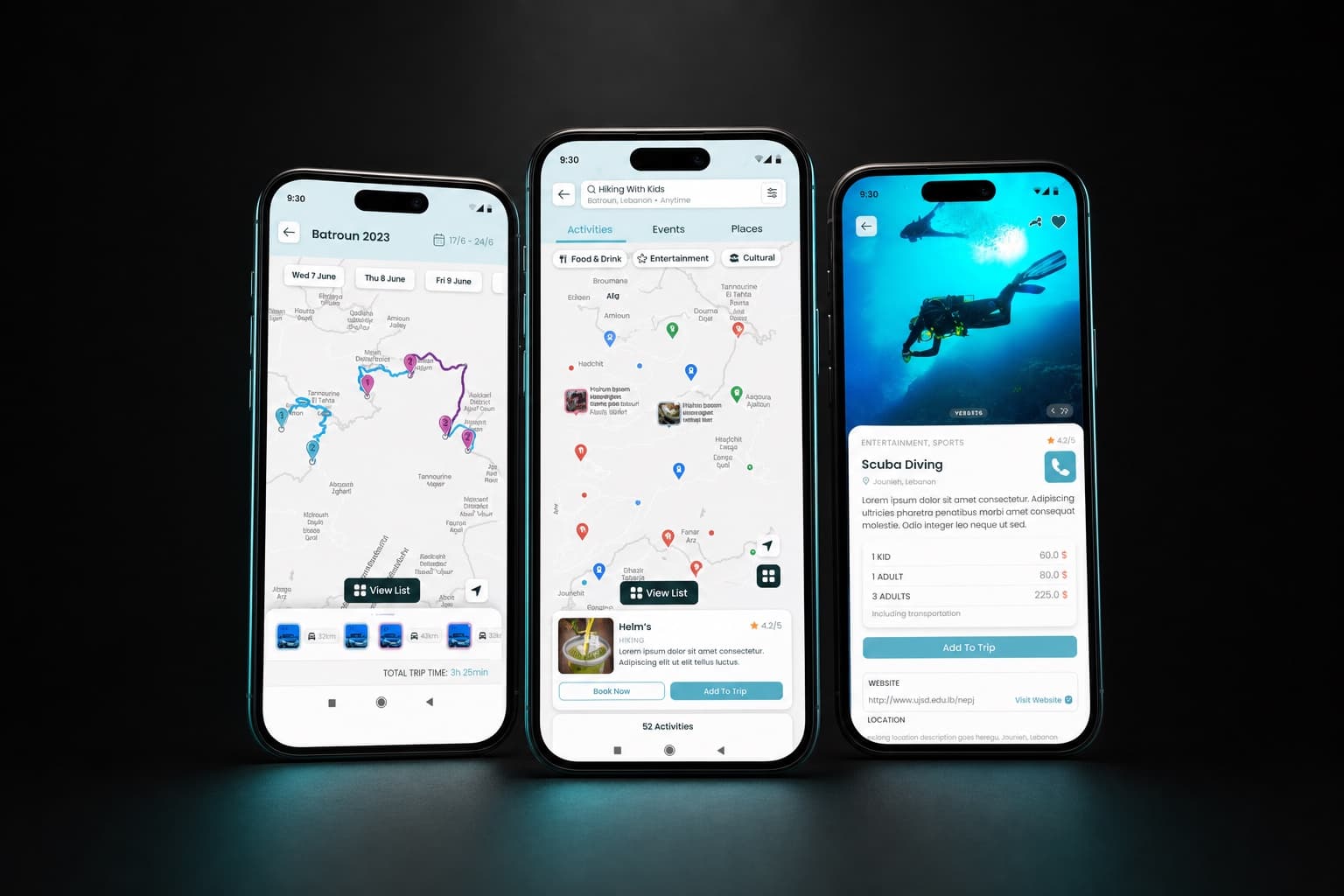
Before partnering with UX Shine, we were leaning toward hiring in-house designers to build our map feature. In just a few weeks, they designed a map experience that streamlined trip planning and introduced strategic ideas. The speed, depth of insight and polished execution would have taken us months to replicate in-house.
Imad Afyouni, CEO and co-founder, Traveln.ai
Traveln.ai faced exactly the choice this article is about. They were about to hire designers for one feature, and chose a studio because they needed it designed and tested within weeks. The full project is in the Traveln.ai case study.
When is an in-house design team better than an agency?
An in-house team is better when design is a permanent, daily part of how your product grows. If you ship features every week, run constant experiments and need a designer in every planning meeting, a team engaged project by project will not match that rhythm. In-house designers also hold knowledge that is hard to hand over: why a decision was made two years ago, which customers complain about what, and how your engineers prefer to work.
The costs are real, though. Hiring takes months, one designer rarely covers research, interface design and design systems equally well, and the team costs the same in quiet months as in busy ones. Many companies combine both: a small in-house team for daily work, and a studio for a new product, a redesign or a specialist area such as AI features or Arabic interfaces.
When does hiring a freelance designer make sense?
A freelancer makes sense for a small, clearly defined task that one person can finish alone. Examples are a set of new screens inside an existing design system, an icon set, or a usability review of one flow.

The risk grows with the size of the work. One person cannot research, design, test and document a full product at the same time, and if they become unavailable the work stops. Check their portfolio for products similar to yours, and agree who owns the files and the components once they leave.
What should you ask yourself before you decide?
Start with how much design work you will have over the next year, not only the next month. Then answer these questions:
- Is this a single project with an end, or continuous work?
- How soon do your engineers need designs they can build from?
- Which skills does the work need: research, interaction design, visual design, design systems, testing, development?
- Does anyone on your team have time to manage designers?
- Does the product need Arabic and English, or AI features, where specific experience matters?
If the answers point to a defined project with a deadline and several skills, a studio is usually the better fit. If they point to years of steady work on one product, start hiring. If it is one small task, a freelancer is enough.
How do you keep control of your product when you work with a design studio?
You keep control by agreeing on scope, decision-makers and handover before work starts. In practice that means:
- One person on your side who can make decisions quickly.
- Regular reviews of real designs and prototypes, not status reports.
- Access to the design files, prototypes and design system from the first week.
- A handover your engineers can build from, or the studio's developers working with them.
We either build the product with our own full-stack development team or work alongside your engineers, and after launch we measure how the design performs. To find out whether your project fits, book a call.